
The Road Marked by Legacy and Love: Healthcare in Zambia’s Wesleyan Mission
Nestled in southwestern Zambia’s Gwembe Valley, the town of Zimba sits astride the bustling Lusaka-Livingstone Road. The highway was originally constructed in the 1930s to connect the Copperbelt with southern African markets. But it also had a magnetic draw that linked rural villages to the towns. Today, as you walk along the road, you hear the constant hum of minibuses converging on the market and trailer trucks hauling sheet copper to the south. The Pilgrim Wesleyan Mission stands alongside shops selling stacks of tomatoes and oranges and bundles of charcoal. Across the road, the Zimba Mission Hospital buzzes with the flurry of patients in and out, while just minutes down the street, the new African Wesleyan University College (AWU) is under construction.
The road, with its flowing traffic past the hospital and college is a fitting picture of the development of the Wesleyan mission in Zambia. Since The Wesleyan Church arrived in the 1930s, it has seen education and healthcare as pathways to introduce people to Christ. Ethel Jordan and Mary Loew, two of the first Wesleyan missionaries in Zambia (Northern Rhodesia at the time), began their work in earnest in 1933, and within months, the Tonga tribe asked them to open a school.
In 1940, the first clinic opened at Jembo, and by 1941 Jordan was coordinating 14 satellite schools. Wesleyan missionaries were sent out to start stations in groups of three in those early days—always including a pastor, a teacher and a nurse—following the pattern set by Ethel Jordan, Mary Loew, Rev. Henry (Alfred) and Cora Reynolds and Rev. and Mrs. R. E. Strickland. Within a decade of Jembo, the families of Rev. Daniel and Madge Bursch and C.G. and Verna Keith had begun new mission stations at Chabbaboma and Siachitema.
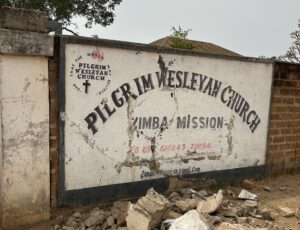 Over time, the benefits of these efforts in health and education became apparent to the rest of the region. In 1957, eight headmen from the roadside village of Zimba approached Field Superintendent Rev. C. G. Keith with a proposition—come and start a hospital in Zimba, and you can establish a mission there as well. The Keiths accepted the offer and, later that year, arrived to survey the land for the new hospital.
If you go to Zimba today, you will find a bigger hospital and the beginnings of a new phase of Wesleyan education at AWU. The hospital hosts 106 beds, a state-of-the-art ophthalmology unit, and the highest level of medical care in the region.
The obvious need for qualified nurses led hospital administrator Prisca Siachitema, in partnership with faculty from Indiana Wesleyan University, to begin the process of establishing a nursing school at Zimba in 2019. Over the next two years, this collaboration allowed Siachitema and then-Bishop of the Pilgrim Wesleyan Church Alfred Kalembo to acquire the resources needed to run the school. In 2021, the nursing school accepted its first intake class. After three years of on-site classroom and clinical experience in the hospital, this first class graduated in 2024.
This vision continues to grow. Kalembo’s dream of opening higher educational opportunities across the continent of Africa has now led to the creation of AWU. Since the breaking of ground in 2023, the foundations have been laid, and the walls of a new nursing building are now rising. Once AWU is completed, the nursing school at Zimba will shift operations to campus.
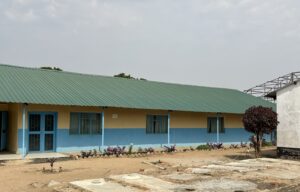
A Nursing classroom at Zimba.
Reverend Alfred Chikobela, the current pastor of Zimba’s Pilgrim Wesleyan Church, highlighted the vital role the hospital plays in the ministry.
“It is a key point for the church… I’ve seen some people that came, that joined the hospital when they were not Wesleyans but eventually they would turn and become Wesleyans,” he said.
Messi Halubbala’s testimony confirms this observation. Growing up in the Salvation Army, she was impressed by the Wesleyan ministry she saw while working at Zimba Hospital. “It was easy for me to join. Then from there, I’m grounded in the Pilgrim Wesleyan Church, and I trained.” She was later baptized by Rev. Chikobela and is now a district overseer.
She also said, “People from all distances, from far away from the villages come to the hospital. Sometimes… they would have no money to buy food, so they used to support them. Whether or not they are Wesleyans, they would still get the support.”
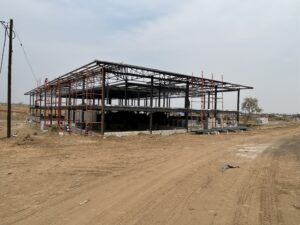
A partially constructed nursing building on Africa Wesleyan University College’s campus.
One is reminded here of John Wesley’s words: “[t]he gospel of Christ knows of no religion but social; no holiness but social holiness.” Ministering to bodies and minds, Wesleyan and non-Wesleyan alike, the Pilgrim Wesleyan Church in Zambia has created a road by which people can encounter the hands and feet of Christ’s mission.
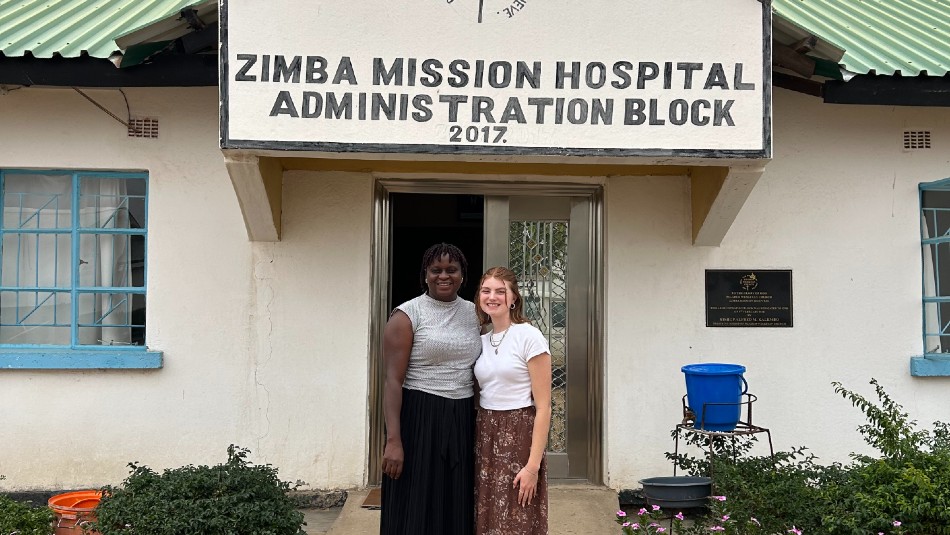
The cover photo at the top captures IWU alumna, Heather Gall (right) with hospital administrator Prisca Siachitema (left), during Heather’s visit in October 2025.